
Trado co-founder Paul Bearman sold a set of chairs through his gallery, Merit, to a buyer across the country. What followed was 41 emails — platform to buyer, buyer to shipper, shipper to seller — over four weeks, before anything moved. Nobody shared a channel. Every handoff diluted the information a little more.
Nobody did anything wrong. The seller followed up. The buyer stayed in contact. The shipper was legitimate. The problem wasn’t any one party. It was a system that put three separate parties in three separate communication channels and called that a delivery.
That’s the standard model. It works well for pallets and packages. For anything else — a vintage chair, a piece of art, an appliance, something with actual value and actual handling requirements — it consistently produces some version of that story. And the scale of that failure is larger than most people realize: more than 12 million tons of used furniture is landfilled in the U.S. every year, much of it not because the items lack value, but because moving them is too complicated, too expensive, or too slow.
Hand-to-hand delivery is built around a different assumption: that the core problem isn’t speed or price alone. It’s the chain of custody.
Why the Standard Delivery Model Breaks Down
Traditional freight and shipping were engineered for pallets, packages, and volume — standardized items moving through standardized systems. That model works when you’re shipping identical widgets by the hundreds. It breaks down the moment your shipment has any specific requirements such as a tight timeline, careful handling, or a value that actually matters to you.
The structural problem is handoffs. In a standard freight model, your item changes hands multiple times between pickup and delivery — from seller to driver, driver to sorting facility, facility to regional hub, hub to local carrier, local carrier to final driver. Each handoff is a moment where responsibility blurs. At any given point, it’s unclear who owns the item, who can answer a question about it, and who bears liability if something goes wrong.
The communication problem follows directly. There’s no single channel connecting the seller, buyer, and carrier, because there’s no single party who spans all of them. So each party chases the next one. The buyer emails the shipper. The shipper calls the seller. The seller contacts the platform. Nobody is in the same room. The 41-email problem isn’t an anomaly. It’s what the system produces by design.
The size and value limits compound everything. The largest on-demand delivery platforms — the ones promising speed and convenience — cap at 30 pounds and $200 in item value. Anything above that threshold gets routed into traditional freight, with typical pickup wait times of three to seven weeks. For a $3,000 set of dining chairs or a vintage piece from a resale marketplace, there’s no middle option. You either wait, or the deal falls apart.
What Hand-to-Hand Delivery Actually Means
The phrase is literal. One person picks up your item. That same person delivers it.
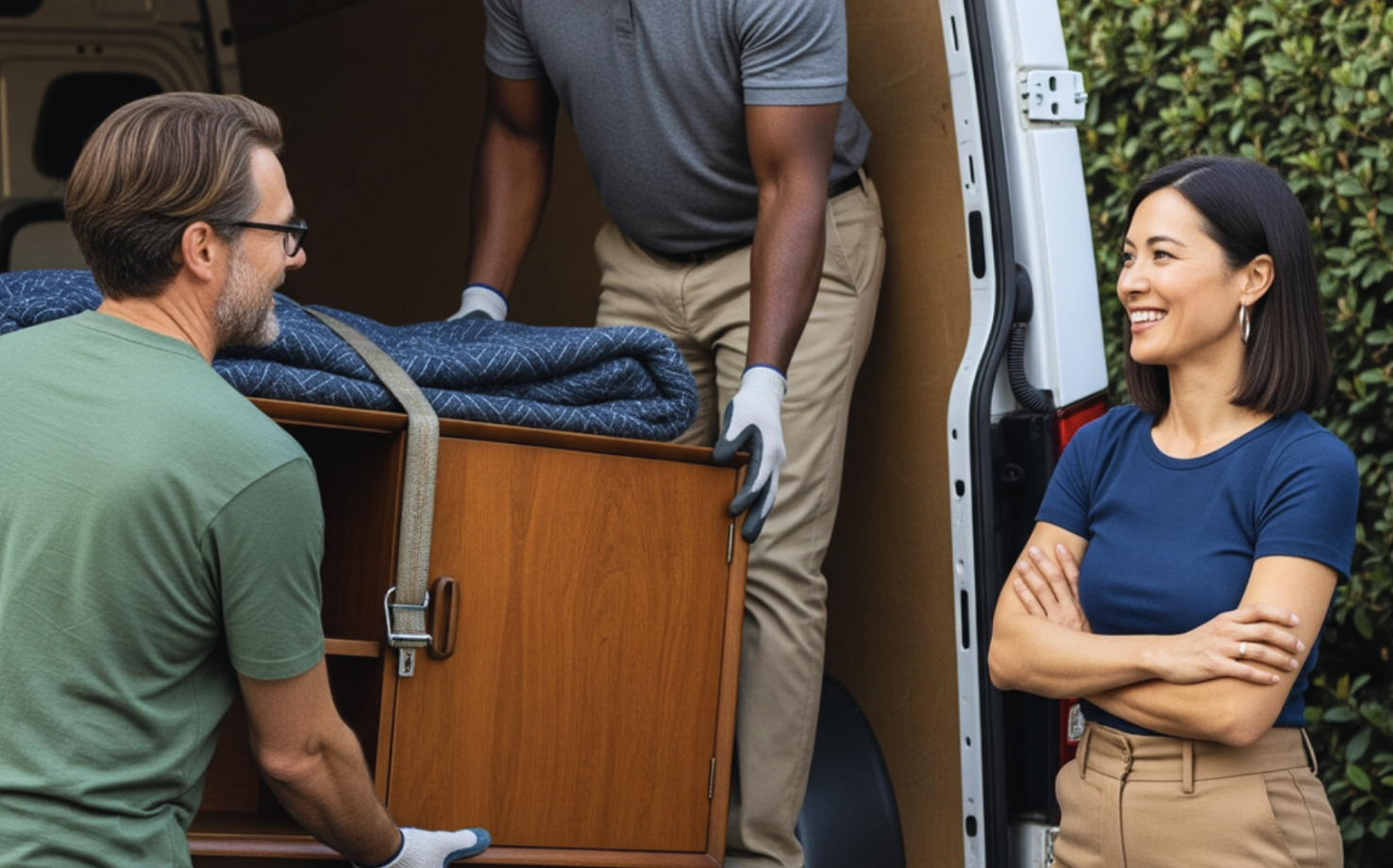
No sorting facility. No transfer station. No anonymous handoff in a warehouse. One vehicle, one trip, one unbroken chain of responsibility from the moment the item is collected to the moment it’s delivered. And because one driver owns the job end to end, all parties — sender, recipient, driver — share a single live conversation tied to that shipment. No chasing updates across disconnected inboxes. No information lost in translation.
The accountability structure changes too. Payment can be held until delivery is confirmed. Shipments can be fully insured. Real-time tracking runs the entire route. When something does need a judgment call — a closed property, an unusual drop-off — a vetted driver can handle it the way a trusted person would, rather than declining the job on liability grounds.
That last part matters more than it sounds. A traditional carrier operates on strict protocols specifically because it can’t vouch for the person making the delivery. Hand-to-hand delivery inverts that. The driver is vetted, connected directly to every party in the shipment, and accountable from start to finish. That’s what makes the judgment call possible, and what makes the whole model work for items that don’t fit a standard protocol.
Take what happened on one cross-country run earlier this year. A driver based in Los Angeles — an entrepreneur running deliveries as a side business alongside his own cross-country drives — got a notification on a morning he was already heading east. By the time he hit the road, he had two shipments lined up: chairs picked up in Chicago and a credenza picked up in the Hamptons, both delivered en route to Rhode Island. One driver, one trip, two senders in different states, everything coordinated through a single platform. The whole run, from Los Angeles to the East Coast, took under three and a half days. No freight network. No relay. No handoffs.
How It Compares to the Alternatives
Several terms in the logistics industry describe adjacent things. None of them are quite the same.
Moving companies are built for volume including the full contents of a home or office, moved on a scheduled day with a crew and a truck. They’re the right call for a household move. They’re not designed for a single item, a resale transaction, or anything that needs to happen today rather than three weeks from now.
White-glove delivery usually refers to inside-room placement and assembly, offered by large retailers for new merchandise. It can include careful handling, but the chain of custody is still traditional freight. Your item still passes through multiple anonymous hands before a white-glove crew appears at the door. The gloves are on the last mile, not the whole trip.
Last-mile delivery describes the final leg of a longer freight journey, from a distribution center to a front door. Hand-to-hand delivery covers the whole route, from wherever the item currently is to wherever it needs to go, without a freight network behind it.
Crowdsourced or peer-to-peer delivery describes how the driver network is recruited, not how the delivery is structured. A crowdsourced driver making four stops on a shared route is the opposite of hand-to-hand. The defining feature isn’t the source of the driver. It’s whether one person owns the job from start to finish.
The practical differences tend to show up in timing and total cost. For a set of vintage dining chairs picked up at a private property in upstate New York and delivered to a buyer in Brooklyn — no recipient present, property closed — hand-to-hand delivery completed the job in under 24 hours for $300. The comparable freight quote for the same job was $600–$900, with a 7–14 day window. A traditional carrier would not have accepted the job at all.

When It’s the Right Model
Not every shipment needs this. If you’re sending a small parcel and the timeline is flexible, standard shipping works fine.
Hand-to-hand delivery earns its place when the standard model’s failure points become actual problems. That tends to happen in a few consistent situations.
Resale and marketplace transactions. The used furniture and resale market in the U.S. is enormous. The global online furniture market alone was valued at $242 billion in 2024, growing at over 20% annually. A significant share of those transactions stall or fall apart at the delivery stage. When a buyer and seller are in different cities, and neither wants to navigate traditional freight, hand-to-hand delivery closes the gap that’s been sitting open between “deal agreed” and “item delivered.”
High-value or irreplaceable items. When the item is worth $1,000, $3,000, or more — or when it has personal or historical significance that can’t be replaced — the risk profile of a multi-handoff freight system becomes real in a way it isn’t for a $40 package. An unbroken chain of custody, insurance from pickup to delivery, and payment held until confirmed receipt changes the math.
Jobs that require judgment. Closed property. No one home for drop-off. Fragile items that need wrapping. Unusual access requirements. These are exactly the scenarios where traditional carriers decline or where things go wrong. A driver who owns the job from start to finish can handle them. A driver who is one leg in a relay can’t.
Anything time-sensitive. Traditional carriers and freight companies work on their own schedule. Same-day or next-day pickup for large or specialty items is generally not available. When the timeline matters — a buyer is waiting, a sale depends on it — hand-to-hand delivery can often respond the day the request is placed.
The Core Idea
Delivery has one job: get something from one person to another, reliably, in one piece, without the runaround.
That sounds simple. The standard logistics system has spent decades proving it isn’t, at least not for everything. Hand-to-hand delivery doesn’t try to optimize the old model. It replaces the assumption that complex, valuable, or oversized items can be handled like interchangeable packages.
Some things need a person who owns the job from the moment it starts to the moment it’s done. That’s what hand-to-hand delivery provides.
Need a large item picked up and delivered, without the runaround?
Services built around hand-to-hand delivery, like Trado, connect you with a vetted driver who handles your shipment start to finish — real-time tracking, full insurance, and a live group chat connecting every party from pickup to drop-off.
Book at trado.io or download the app.